
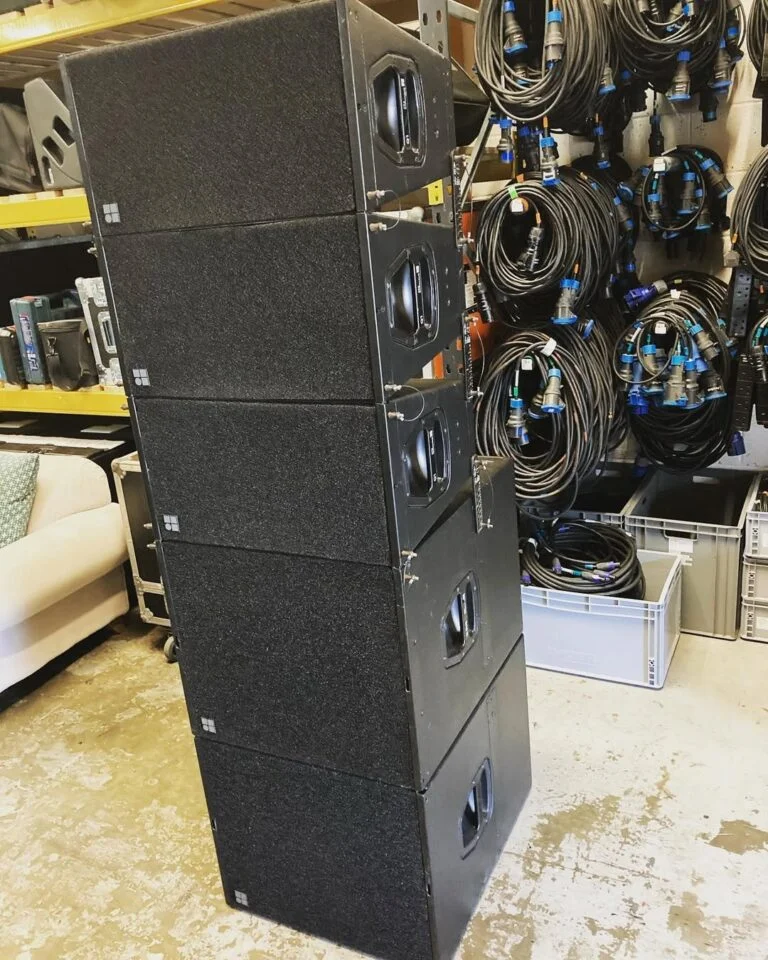
D&B Q1s
€1,500.00
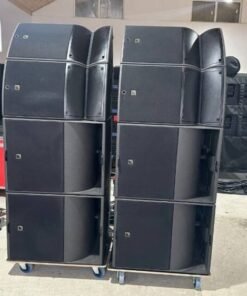
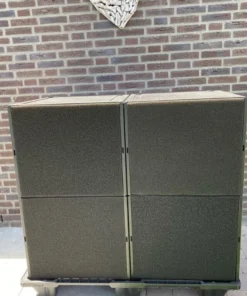
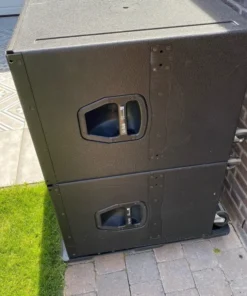
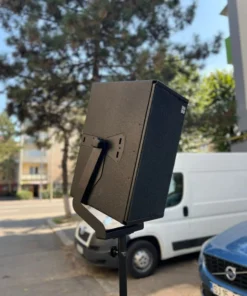
Build or expand an established Q-Series array with these d&b Q1s for sale. Each passive two-way cabinet combines 2 × 10″ LF drivers, a 1.3″ HF compression driver, 75° horizontal directivity and adjustable array splay from 0° to 14°. A practical professional solution for touring, rental, festival and venue systems using compatible d&b amplification.
d&b Q1s for Sale | Professional Q-Series Line Array Loudspeakers
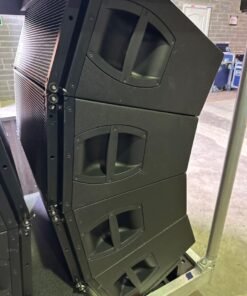
The d&b Q1s for sale are professional passive two-way line-array loudspeakers developed for vertical array configurations where controlled coverage, compact dimensions and high acoustic output are important. Each Q1 combines two 10-inch low-frequency drivers with a 1.3-inch compression driver, delivering 75° horizontal directivity while allowing adjustable vertical splay between cabinets. For European rental companies, venues and production businesses maintaining Q-Series systems, Q1s remain especially useful for expanding an established professional inventory.
Rather than operating like conventional standalone PA cabinets, Q1s are designed to work together. By changing the angle between individual enclosures, system designers can create array shapes suited to different audience areas and venue layouts.
Why d&b Q1s Remain Useful for Professional Systems
The Q1 combines a compact enclosure with an acoustic design developed specifically for line-array deployment.
Each cabinet contains:
- 2 × 10″ LF drivers
- 1 × 1.3″ HF compression driver
- Toroidal waveguide
- Passive two-way crossover architecture
- Integrated Q-Series rigging
- 75° nominal horizontal dispersion
- 15° nominal vertical dispersion per cabinet
Consequently, multiple Q1s can form a coherent professional array rather than functioning as unrelated individual loudspeakers.
d&b Q1 Technical Specifications
| Specification | Details |
|---|---|
| System Type | Passive 2-way line-array element |
| LF Drivers | 2 × 10″ |
| HF Driver | 1 × 1.3″ compression driver |
| Horizontal Dispersion | 75° |
| Vertical Dispersion | 15° per cabinet |
| Splay Range | 0°–14° |
| Frequency Response | Approx. 60 Hz – 17 kHz |
| Power Handling | 400 W RMS / 1600 W peak |
| Stated Maximum SPL | Up to approx. 139 dB* |
| Enclosure | Plywood |
| Connections | NL4 or EP5 depending on version |
| Dimensions | Approx. 308 × 580 × 410 mm |
| Weight | Approx. 22 kg |
*Maximum output depends on amplifier, configuration and measurement conditions.
Dual 10-Inch Low-Frequency Architecture
Each Q1 uses two 10-inch low-frequency drivers in a dipolar arrangement.
This acoustic configuration contributes to the cabinet’s controlled horizontal behavior while providing substantial output from a relatively compact enclosure.
Meanwhile, the dedicated high-frequency compression driver works through a toroidal waveguide.
Together, these components allow multiple Q1 cabinets to interact as an array while maintaining controlled audience coverage.
75° Horizontal Directivity
A major advantage of the Q1 is its 75° horizontal constant-directivity pattern.
Instead of spreading acoustic energy extremely widely, the cabinet concentrates coverage within a defined horizontal area.
This becomes especially useful when several Q1s are combined vertically.
The horizontal pattern remains focused while the array’s vertical coverage can be shaped according to cabinet quantity and splay angles.
Therefore, system designers can address different venue geometries without changing loudspeaker models.
Flexible 0° to 14° Splay Angles
Vertical array shaping is one of the defining features of Q1.
Adjacent cabinets can use different splay angles within the supported 0° to 14° range.
Smaller angles can help form sections intended for greater projection. Meanwhile, wider angles can provide increased vertical coverage for audience areas closer to the array.
A professional system designer can therefore create a progressively curved array rather than pointing every cabinet in exactly the same direction.
15° Vertical Coverage Per Q1
Each cabinet provides approximately 15° nominal vertical dispersion in the relevant high-frequency range.
However, buyers should not simply multiply 15° by the number of speakers to calculate total system coverage.
Array interaction, splay angles, mounting height and venue geometry all affect the final result.
Therefore, larger Q1 systems should be designed using appropriate d&b system-planning methods rather than simple arithmetic.
d&b Q1s for Sale for Touring and Rental Companies
These d&b Q1s for sale are particularly relevant to businesses that already own Q-Series equipment.
For example, additional cabinets can allow a rental company to increase array size for larger productions while using smaller configurations for other events.
They can also serve as backup inventory or help create an additional complete system.
Typical professional applications include:
- Concert touring
- Festivals
- Professional PA rental
- Theatres
- Live music venues
- Corporate productions
- Event sound
- Performance venues
- Fixed professional installations
- Existing Q-Series system expansion
Standard Frequency Response from Around 60 Hz
The supplied Q1 specifications give a standard frequency response of approximately 60 Hz to 17 kHz.
That provides useful low-frequency extension for a compact line-array cabinet.
However, large-scale music applications will generally benefit from dedicated subwoofers.
When appropriately configured subwoofers handle the lower frequencies, the Q1 can use dedicated processing modes to optimize its role within the complete system.
Pair Q1s with Q-SUB
For a complete Q-Series setup, Q-SUB provides a natural low-frequency partner.
The Q-SUB uses a dedicated 18-inch driver and was designed within the same professional Q-Series ecosystem.
Therefore, combining Q1s with suitable Q-SUB inventory can create a more complete system in which the array handles audience coverage while the subwoofers provide dedicated low-frequency reinforcement.
This can be particularly attractive for companies purchasing additional Q1 cabinets to complement Q-SUBs they already own.
CUT Mode with Subwoofer Systems
When Q1 operates with suitable subwoofers, compatible d&b amplification provides CUT mode.
CUT reduces low-frequency output from the Q1, allowing the dedicated subwoofers to handle more of that frequency range.
Consequently, the Q1 array can concentrate more effectively on its primary operating range.
This is another reason correct d&b processing matters when building a complete Q-Series system.
HFC for Long-Distance Coverage
Q1 systems can also use High Frequency Compensation (HFC) through compatible d&b amplification.
High-frequency energy is affected by air absorption over distance. Therefore, cabinets covering distant audience areas may require different processing from cabinets addressing listeners close to the array.
HFC provides an integrated way of compensating for this effect within supported system configurations.
This can be particularly useful for outdoor events and larger venues.
CPL for Array Coupling
Another useful processing function is CPL, or Coupling.
As more cabinets combine into an array, their acoustic interaction changes.
CPL allows system technicians to adjust aspects of this behavior through compatible d&b processing.
Therefore, a larger Q1 array does not have to be treated simply as several independent loudspeakers stacked together.
Professional Q-Series Rigging
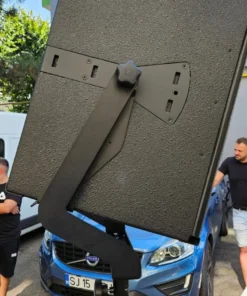
Integrated rigging allows Q1 cabinets to connect mechanically into supported vertical-array configurations.
This helps technicians establish the required splay angles while creating the intended array geometry.
However, suspended loudspeaker systems require careful professional planning.
Before flying Q1s, users should inspect the cabinets and rigging components and follow the applicable d&b documentation regarding array configuration, load limits and suspension.
Only appropriately qualified personnel should handle safety-critical rigging.
Approximately 22 kg Per Cabinet
Each Q1 weighs approximately 22 kg.
Its dimensions are roughly:
Height: 308 mm
Width: 580 mm
Depth: 410 mm
This relatively compact format is valuable when a touring system contains many cabinets.
For example, reducing the size and weight of each enclosure can influence truck space, warehouse storage and setup logistics when dozens of loudspeakers are involved.
Road-Ready Cabinet Construction
The Q1 enclosure uses robust plywood construction with a durable protective finish.
A rigid metal grille protects the front of the loudspeaker, while acoustically transparent foam provides an additional layer behind it.
Integrated handling and rigging components support professional deployment.
Nevertheless, used Q1s should be evaluated individually for enclosure, driver, connector and rigging condition before being placed into service.
NL4 and EP5 Versions
Connector configuration can vary depending on the specific Q1 version.
Some cabinets use NL4, while other inventories may contain EP5 versions.
Therefore, buyers should confirm the exact connectors before purchasing additional Q1s.
This is particularly important when adding speakers to an existing rental inventory because the new cabinets should integrate efficiently with existing amplifier racks and cable systems.
Compatible d&b Amplification
Q1 requires suitable d&b amplification and loudspeaker processing.
Different d&b amplifier generations have supported Q-Series equipment. However, professional users should verify the approved configuration for the exact amplifier they intend to use.
Correct amplification provides more than sufficient wattage. It also supplies the loudspeaker-specific processing, protection and operating modes required by the system.
Expanding an Existing Q-Series Inventory
Finding several d&b Q1s for sale can be more valuable to an existing Q-Series owner than purchasing a completely different loudspeaker platform.
Your business may already have:
- Q-SUB cabinets
- Compatible d&b amplifiers
- Q-Series rigging
- Speaker cabling
- Transport equipment
- Trained technicians familiar with Q-Series
Therefore, additional Q1s can expand system capacity without requiring an entirely new supporting infrastructure.
Previous-Generation Professional Line Array
The Q1 belongs to an established previous generation of d&b line-array technology.
It should therefore be marketed transparently as professional legacy equipment rather than presented as a current d&b model.
Nevertheless, that does not eliminate its value for companies maintaining compatible Q-Series systems.
Instead, buyers should pay particular attention to the condition of the drivers, enclosure, connectors and integrated rigging.
Buying d&b Q1s for Sale in Europe
Euro Electronic Space offers d&b Q1s for sale in Europe for professional buyers looking to expand or complete compatible Q-Series systems.
Delivery can be arranged to supported European destinations, including Germany, the Netherlands, France and Italy.
For larger quantities, multiple cabinets can be consolidated for freight. Furthermore, buyers can enquire about compatible Q-SUBs, amplifiers and Q-Series accessories when available.
Frequently Asked Questions About d&b Q1
Is Q1 a line-array speaker?
Yes. Q1 is a passive two-way loudspeaker specifically developed for professional vertical line-array configurations.
How many drivers are inside each Q1?
Each cabinet contains two 10-inch LF drivers and one 1.3-inch HF compression driver.
What is the horizontal coverage?
The nominal horizontal dispersion is approximately 75°.
What splay angles are available?
Supported inter-cabinet angles range from approximately 0° to 14°.
How much does each Q1 weigh?
Approximately 22 kg.
Can Q1 be used with Q-SUB?
Yes. Q-SUB was developed as a low-frequency component within the Q-Series ecosystem and can form part of appropriately designed Q1 systems.
Can Q1 cabinets be flown?
Yes. Q1 incorporates professional array rigging. However, all flown configurations must comply with the applicable d&b rigging documentation and relevant safety requirements.
Are Q1 speakers still useful for professional applications?
They can be particularly useful for businesses that already maintain compatible Q-Series equipment, amplification and rigging.
Be the first to review “D&B Q1s”
Related products
Complete System
Complete System
Complete System
Complete System
Complete System
D&B Audiotechnik
D&B Audiotechnik
Complete System
Reviews
There are no reviews yet.