
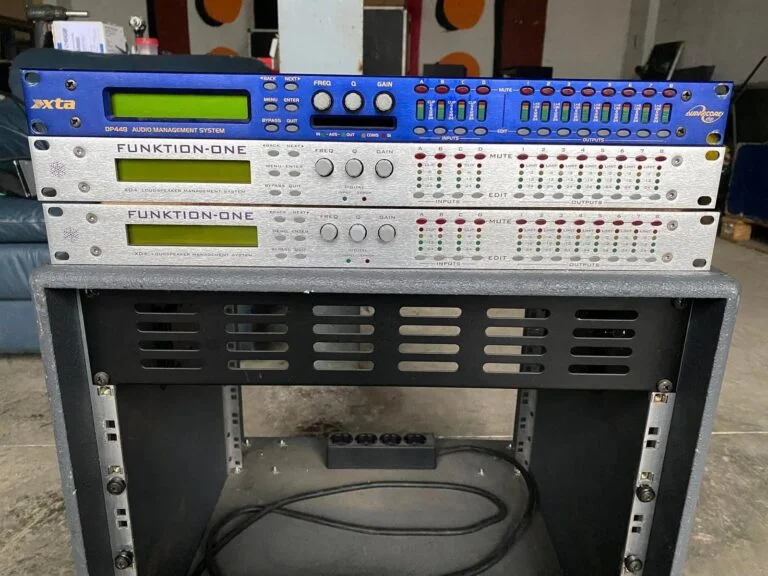
Funktion One XTA DP448 DSP 4 IN 8 OUT Processor

€1,000.00
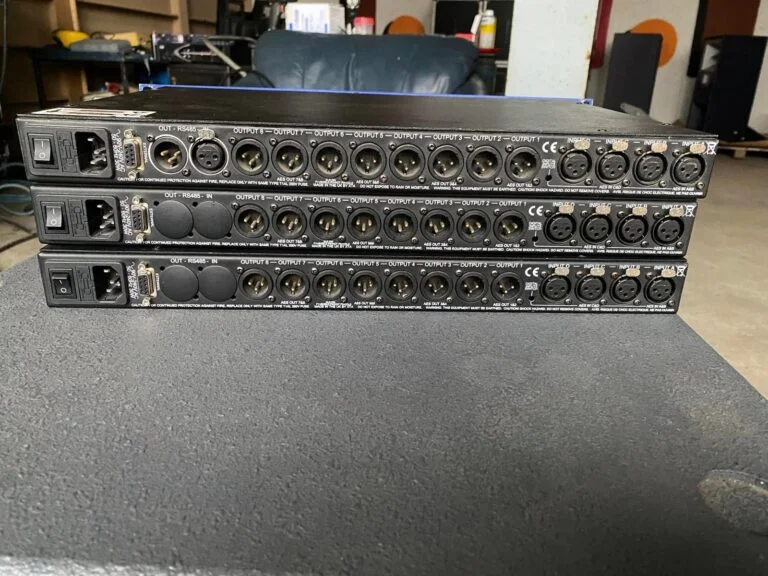
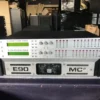
Precise system management for demanding professional PA configurations. The Funktion-One XTA DP448 DSP 4 In 8 Out Processor for sale provides 4 balanced inputs, 8 balanced outputs and 96 kHz digital processing with flexible routing, crossover, EQ, delay and system-control capabilities. An excellent processing solution for Funktion-One club, touring, rental and fixed sound systems.
Funktion-One XTA DP448 DSP 4 In 8 Out Processor for Sale
The Funktion-One XTA DP448 DSP 4 In 8 Out Processor for sale is a professional loudspeaker-management solution designed for demanding Funktion-One sound systems. With four inputs, eight outputs, flexible signal routing and comprehensive DSP control, this processor gives system engineers the tools required to manage crossovers, EQ, delay, limiting and system alignment from a single rack-mounted unit. It is a strong choice for professional clubs, touring systems, rental companies, live venues and fixed installations throughout Europe.
Rather than simply splitting an audio signal between loudspeakers, this processor provides detailed control over how each section of a professional PA operates. As a result, it becomes particularly useful in multi-way Funktion-One systems containing separate tops, bass and infrabass sections.
Funktion-One XTA DP448 DSP Processor Overview
The processor combines a 4-input / 8-output architecture with professional digital signal management.
| Feature | Details |
|---|---|
| Processor Type | Digital loudspeaker management |
| Platform | XTA DP448-based |
| Inputs | 4 balanced inputs |
| Outputs | 8 balanced outputs |
| DSP Sampling | 96 kHz |
| Routing | Flexible input/output matrix |
| Processing | EQ, crossover, delay, limiting, gain and polarity |
| Rack Format | 1U, 19-inch |
| Remote Management | XTA AudioCore-compatible configurations |
| Primary Use | Professional PA management |
This configuration provides enough output channels to manage considerably more sophisticated systems than a conventional stereo crossover.
4 Inputs and 8 Outputs for Complex PA Systems
The main advantage of the Funktion-One XTA DP448 DSP 4 In 8 Out Processor is its channel architecture.
Four inputs allow several source or system feeds to enter the processor, while eight outputs provide independent signal paths for different loudspeaker sections.
Depending on the professionally engineered configuration, those outputs can be assigned to different parts of a sound system.
For example, a large multi-way system may need independent processing for main loudspeakers, bass cabinets, infrabass sections or additional coverage zones.
Therefore, the eight-output format gives system engineers significantly more freedom when designing complex PA configurations.
96 kHz Digital Signal Processing
High-quality digital processing is particularly important in professional sound systems.
The XTA platform uses 96 kHz DSP, allowing detailed signal processing while maintaining the performance required for professional audio applications.
However, the value of the processor goes beyond its sampling rate.
The real advantage comes from combining high-resolution processing with precise control over crossover filters, EQ, delays, output levels and system protection.
Flexible Matrix Routing
Professional systems do not always follow a simple input-one-to-output-one configuration.
Flexible matrix routing allows incoming signals to be assigned to appropriate outputs according to the system design.
This makes the processor useful for more elaborate installations where different loudspeaker sections need different feeds or processing.
Consequently, one processor can become the central management point between the audio source and several amplifier channels.
Professional Crossover Management
Crossover control is one of the most important functions of this Funktion-One XTA DP448 DSP 4 In 8 Out Processor for sale.
In a multi-way PA, different loudspeaker sections are designed to reproduce different parts of the frequency spectrum.
The processor can therefore be configured to direct the appropriate frequencies to the corresponding amplifier and loudspeaker channels.
Correct crossover design can help the system operate as one integrated setup rather than several independent speakers competing across the same frequency range.
Parametric EQ and System Tuning
Equalization provides another important layer of control.
Professional system engineers can use appropriate EQ functions to shape individual inputs or outputs according to system requirements.
This can be useful when integrating multiple loudspeaker sections or adapting a system to a particular deployment.
Nevertheless, EQ should not replace proper loudspeaker placement and acoustic system design. It works best as part of a complete tuning process.
Precise Delay and Time Alignment
Large professional PA systems often place different loudspeaker elements at different physical distances from the audience.
Without suitable alignment, those differences can affect how the individual system sections combine.
Digital delay allows an engineer to compensate for relevant timing differences.
Therefore, the processor can play an important role when aligning:
- Main loudspeakers
- Bass sections
- Infrabass systems
- Fill speakers
- Delay systems
- Additional coverage zones
Accurate measurements and professional system tuning remain essential when determining the appropriate settings.
Output Limiting and Loudspeaker Protection
Professional sound systems also need carefully configured protection.
Output limiting can help keep signals within appropriate operating parameters when correctly configured for the associated amplification and loudspeakers.
This becomes especially important with high-output Funktion-One systems.
However, limiter settings should never be guessed. They need to reflect the actual loudspeaker, amplifier and system configuration.
Funktion-One XTA DP448 DSP for Multi-Way Systems
A major reason buyers search for a Funktion-One XTA DP448 DSP 4 In 8 Out Processor for sale is multi-way system management.
Consider a professional system containing:
Resolution tops → dedicated processing
Bass section → dedicated processing
Infrabass section → dedicated processing
Each section can require different crossover, EQ, delay and protection parameters.
A processor with eight outputs gives the engineer the channel capacity needed to manage these sections more effectively.
Ideal for Funktion-One Club Systems
Professional club systems are among the most natural applications for this type of processor.
Clubs often use multi-way loudspeaker configurations designed around the room rather than simple left/right speakers.
A central DSP platform allows the system engineer to control how those individual elements work together.
Potential applications include:
- Nightclubs
- Electronic music venues
- Live music venues
- Professional DJ systems
- Concert spaces
- Touring PA
- Festivals
- Rental systems
- Event production
- Fixed professional installations
Useful with Resolution and Bass Systems
The processor may be particularly relevant to operators using established Funktion-One systems containing multiple loudspeaker types.
For example, businesses working with Resolution Series cabinets alongside dedicated bass and infrabass equipment need appropriate system management between the source and amplification.
The processor can provide that management layer when configured with the correct settings for the actual system.
Remote System Management
Compatible XTA control environments can provide remote access to processor parameters, depending on the exact hardware and communication configuration.
For professional installations, remote control can make system commissioning and adjustments considerably more convenient.
Instead of making every change from the front panel, an engineer can work from a suitable control position while evaluating the PA.
This is especially useful in larger venues where the equipment rack may be located far from the main listening position.
Compact 1U Rack Format
Despite providing four inputs and eight outputs, the processor uses a compact professional rack format.
A 1U 19-inch chassis helps preserve valuable rack space.
This can be especially important in touring and installation racks that already contain multiple amplifiers, power distribution and additional signal-management equipment.
As a result, sophisticated processing does not necessarily require a large amount of additional rack space.
Where the Processor Sits in Your Sound System
A simplified professional signal path could look like this:
Mixer / Audio Source → Funktion-One/XTA DSP Processor → Power Amplifiers → Loudspeakers
The processor sits between the source and amplification.
At this point, it can manage routing and apply the appropriate system processing before signals reach the amplifiers.
Therefore, it should be viewed as a central part of the PA architecture rather than simply another rack accessory.
Professional Configuration Is Essential
A processor this flexible should be configured by someone who understands the loudspeaker system being used.
Important parameters may include:
- Crossover frequencies
- Filter slopes
- Parametric EQ
- Output gain
- Delay
- Polarity
- Limiters
- Routing
- Presets
Incorrect settings can prevent a professional loudspeaker system from operating as intended.
For that reason, buyers should use verified settings appropriate to their particular Funktion-One equipment and system design.
Why Choose a 4-In / 8-Out Processor?
The advantage is flexibility.
A smaller processor may be adequate for a simple top-and-sub PA. However, professional Funktion-One systems can involve considerably more signal paths.
With four inputs and eight outputs, this platform provides additional capacity for multi-way processing, stereo configurations and more complex system architectures.
Furthermore, having crossover, EQ, delay, routing and protection management within one processor can simplify the overall signal chain.
Buy Funktion-One XTA DP448 DSP 4 In 8 Out Processor in Europe
Euro Electronic Space offers the Funktion-One XTA DP448 DSP 4 In 8 Out Processor for sale in Europe for professional sound companies, clubs, installers, rental businesses and Funktion-One system operators.
Shipping can be arranged to supported destinations throughout Germany, the Netherlands, France and Italy, as well as other European markets.
International delivery can also be arranged where supported.
Frequently Asked Questions
How many inputs does the Funktion-One XTA DP448 DSP have?
The processor provides four inputs.
How many outputs does it have?
It provides eight outputs, making it suitable for more complex professional loudspeaker configurations.
What does the processor control?
Its professional DSP functions can be used for tasks such as crossover management, EQ, delay, gain, polarity, limiting and signal routing, depending on the configuration.
Is this a power amplifier?
No. This is a digital loudspeaker-management processor. Separate power amplification is required to drive passive loudspeakers.
Can it manage a multi-way Funktion-One system?
Yes, that is one of the most relevant applications for a 4-input/8-output professional processor. However, the exact settings must correspond to the specific loudspeakers and amplifiers.
Is it suitable for club sound systems?
Yes. Professional club installations are a strong use case, particularly when several loudspeaker sections require independent processing.
Does it support remote control?
XTA-based systems can support remote management through compatible control arrangements. The exact connectivity of the particular hardware version should be confirmed before purchase.
Can it be rack mounted?
Yes. It uses a professional 19-inch rackmount format.
Be the first to review “Funktion One XTA DP448 DSP 4 IN 8 OUT Processor”
Related products
Complete System
Complete System
Complete System
Complete System
Complete System
Complete System
Complete System
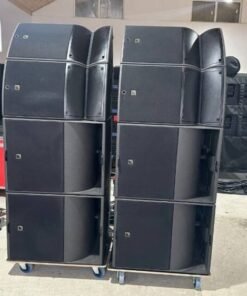
Complete System
Reviews
There are no reviews yet.